01 intro.md

Hegemann Schorsch is an applied lab for artificial intelligence in Frankfurt am Main. We build AI systems you can check: a project in civic education, data-sovereign tools for companies, and a learning platform for children.

Two founders, one principle: the machine reads, a human decides.

Host
hegemann-schorsch.de Frankfurt am Main
Kernel
Physics finance 2 founders
Packages
6 projects: 3 live, 2 open source, 1 in progress
Models
Claude, Gemini, local open-source models: by task, never by habit
Trackers
0 cookies 0 external scripts 0
Contact
kontakt@hegemann-schorsch.de

02 projects/

6 folders open all close all

bundestakt/ Every session of the German Bundestag, analysed in full and sourced live

Bundestakt

Der Bundestag redet. Wir erklären es euch.

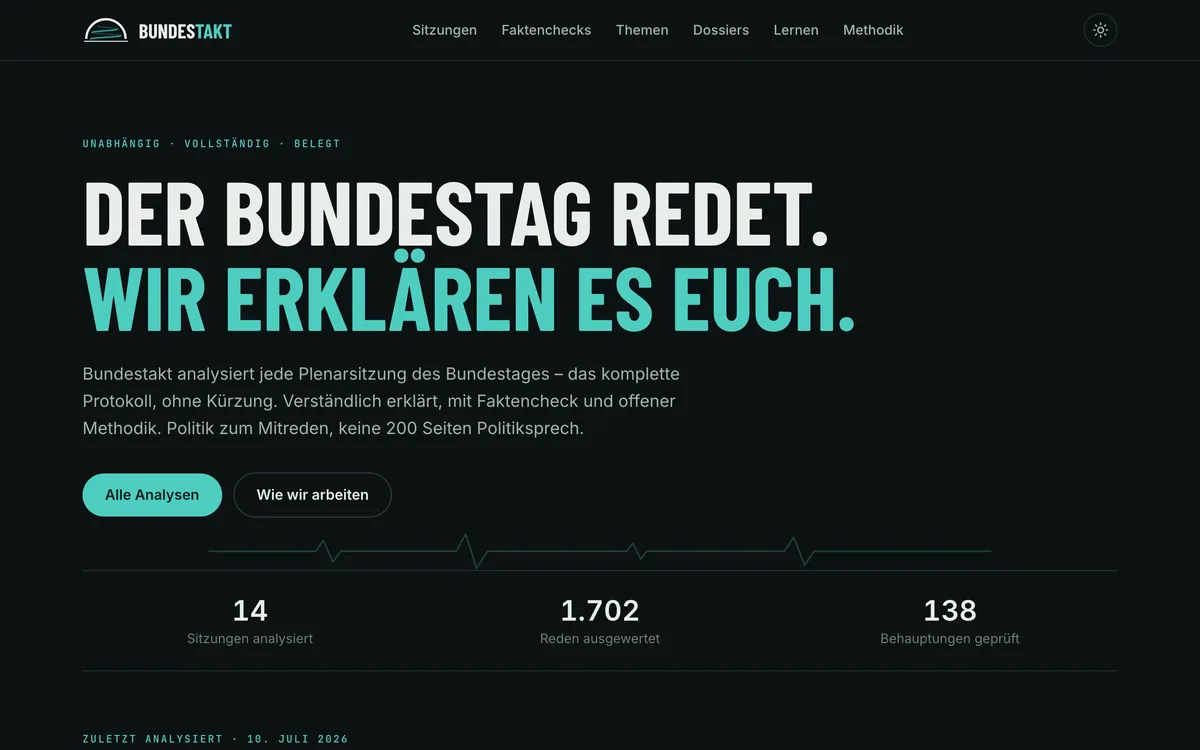
Bundestakt analyses every plenary session of the German Bundestag in full: the complete transcript, nothing cut. Every speech, every heckle, every vote. Explained in plain language, with sourced fact-checks and a methodology that is public on the site.

A plenary transcript runs to about 200 pages. A language model with a one-million-token context reads all of it. Every quote is checked against the original, every claim researched live against primary sources. Nothing goes online automatically: an editor signs off every publication.

Independent, ad-free, non-commercial and not affiliated with the German Bundestag. Approved analyses and fact-checks are available through an open JSON API under CC BY 4.0. The site is in German.

Status
live 21st legislative period
Data
Official plenary transcripts via the Bundestag's DIP interface
Stack
Next.js Claude Opus 5 with a 1M context Postgres Inngest
Licence
Data CC BY 4.0, open API
  • 14 sessions analysed
  • 1,702 speeches evaluated
  • 138 claims fact-checked
  • 100 % editorially approved

As of September 2026. Live figures on bundestakt.de.

[01] Every party, the same criteria

Every analysis treats every parliamentary group by identical, published standards. There is not a single party-specific rule in the prompts or the code.

[02] The complete transcript

Every speech, every heckle, every vote. What the pipeline cannot read in full, it does not judge.

[03] Sourced

Primary sources first: the Federal Statistical Office, Bundestag printed papers, the parliamentary research service, the Bundesbank, Eurostat. Without a solid source the verdict is “unverifiable”, not “false”.

[04] A human decides

No fact-check goes online automatically. The AI is the research tool; people carry the responsibility for every publication.

Populism runs on claims that nobody checks. We make checking cheap.

Niklas Hegemann and Sebastian Schorsch, founders
The bundestakt.de home page, headlined “Der Bundestag redet. Wir erklären es euch.”, with the figures 14 sessions, 1,702 speeches and 138 fact-checked claims
parlance-ai/ Query company data in plain language, on-premises and auditable live

Parlance AI

Ask the question. Compute the answer.

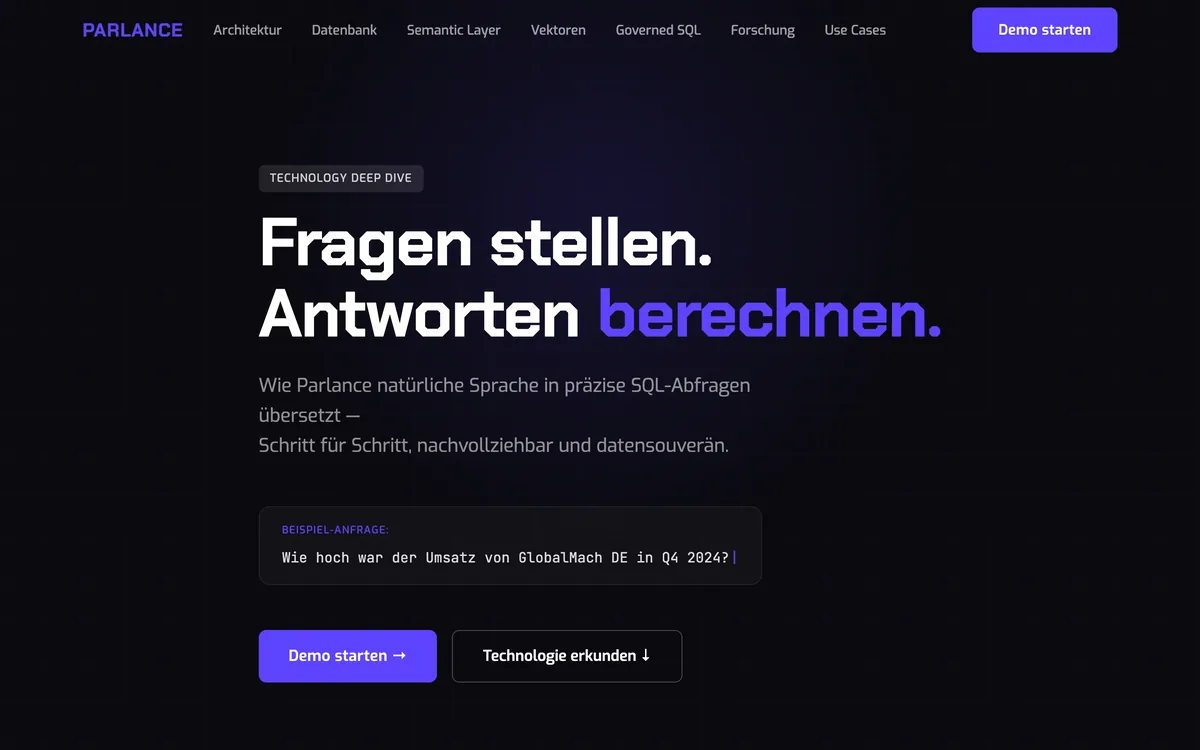
Parlance lets people query company data in plain language. A question like “How did revenue by product line develop in Q4?” is translated into an SQL statement, executed, and answered with its source, the statement and an audit entry. Computed, not guessed.

The core is called Governed SQL: only read statements are allowed; writes and schema changes are blocked by the system, not by configuration. Every request lands in the audit log with statement, result, timestamp and user. The language model can run in the customer's own data centre; neither metadata nor payload leaves the building.

A four-stage agent decomposes the question, pulls context from documents and a semantic layer, generates several SQL candidates and reconciles their results. Successful requests are stored as examples in a vector database: the system gets more precise with every use.

Status
live
For
Banks, insurers and mid-sized companies with an ERP that cannot hand their data to anyone
Stack
Agentic pipeline semantic layer vector DB Claude or local models via Ollama and LM Studio
Next
Text-to-API for SAP S/4HANA, in trials
The parlance-ai.de home page, headlined “Fragen stellen. Antworten berechnen.”, with an example query for Q4 2024 revenue
kiwi/ KI Wonder Island: children aged 5 to 13 learn how AI works live

KIWI – KI Wonder Island

Learn AI by playing.

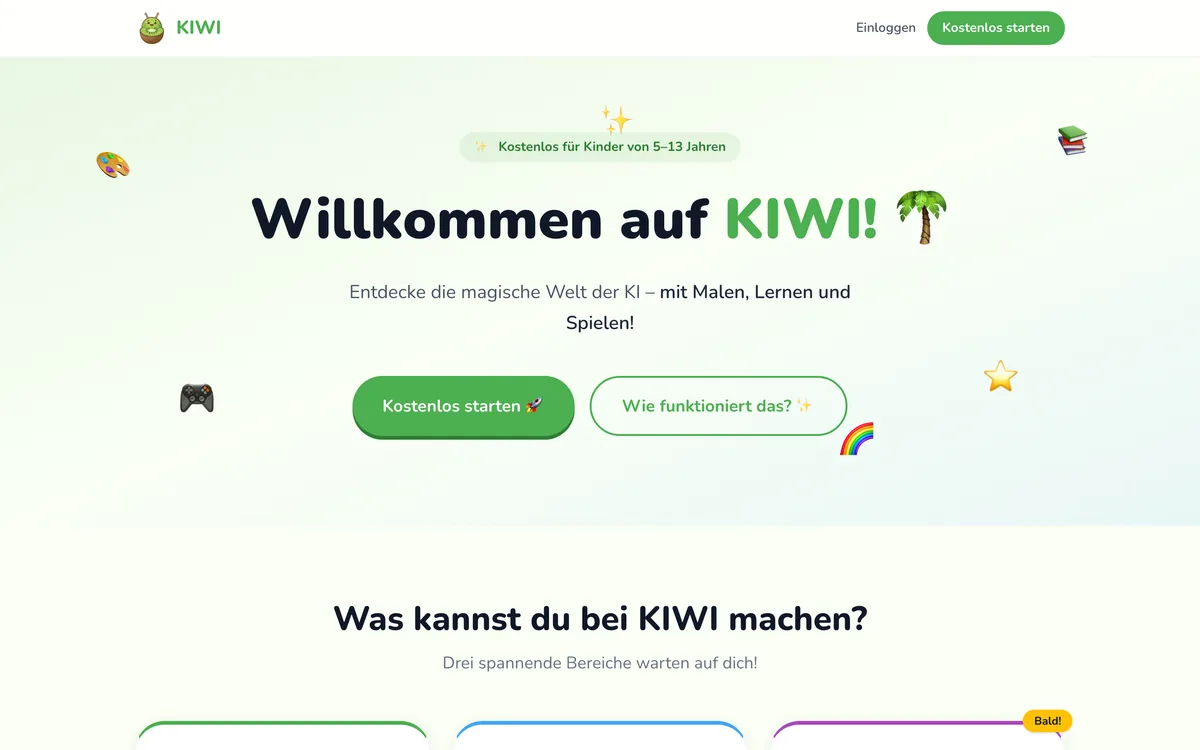
KIWI is a learning platform for children aged five to thirteen, in German. A description becomes a colouring page. Arithmetic and reading arrive as exercises along the primary-school curriculum, from preschool to grade 4. And in two games children learn how AI actually works: in the driving school they teach a car to drive, every keystroke a training example. In the workshop they steer an AI with cards: input, processing, output.

Safety here is architecture, not a promise. Every input passes a blocklist and is cleaned before it reaches a model; every output is checked. Parents see every generated picture together with the original input, can switch features off, and can export or delete all data with one click.

Status
live free
Age
5 to 13, exercises from preschool to grade 4
Stack
Next.js Supabase Gemini a hand-written k-NN learner that runs in the child's browser
Data
No tracking, no ads, hosted in Frankfurt, GDPR export and deletion
The kiwi4you.de home page: “Willkommen auf KIWI!”, free for children aged 5 to 13, with painting, learning and playing
opendiff/ Compare two documents word by word, without anything leaving the device open source

opendiff

Two versions, every change. Nothing leaves your device.

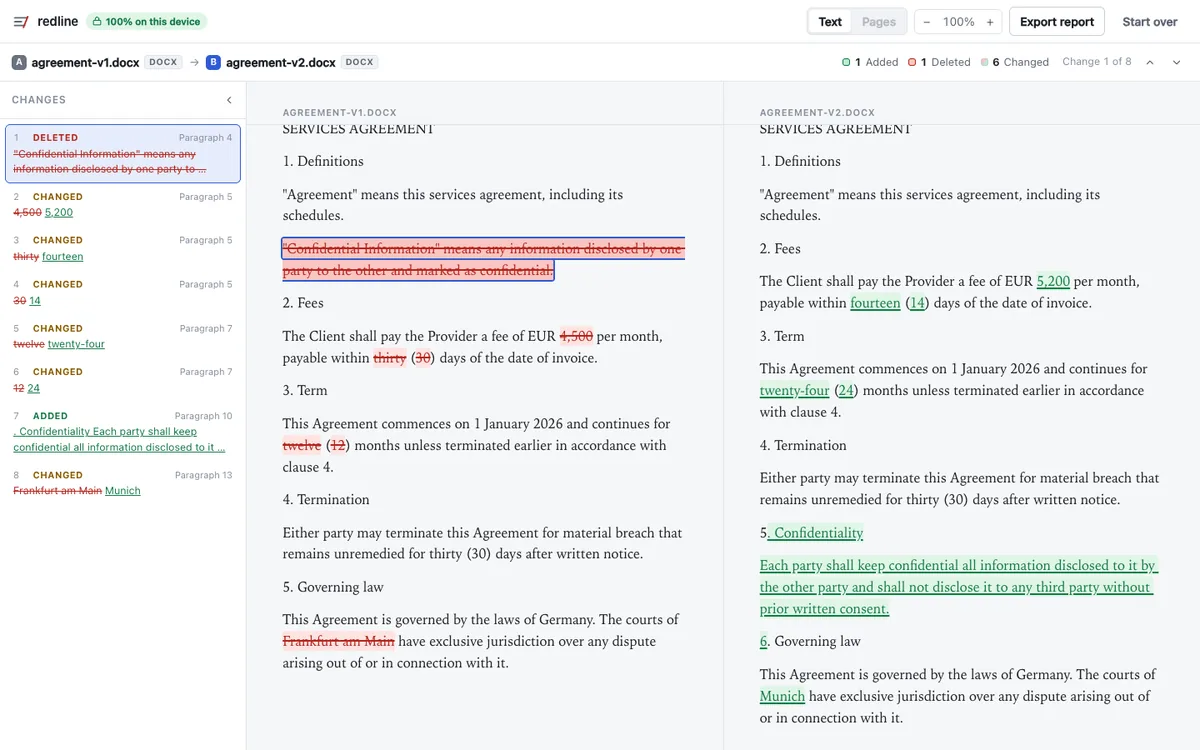
redline shows every change between two versions of a document, word by word and side by side: deletions in red, insertions in green, with a change list to jump through. PDF, Word, OpenDocument, plain text and Markdown, in any combination.

The application runs entirely in the browser: no upload, no server, no network request after the first load. Installable as a web app, and then it works offline too. Vanilla JavaScript with no build step, under the Apache-2.0 licence.

Status
open source Apache-2.0
Formats
PDF DOCX ODT TXT MD
Stack
Vanilla JS pdf.js web workers service worker
Data
100 % on your own device
redline comparing two versions of a contract side by side: deleted passages struck through in red, new ones underlined in green, the list of eight changes on the left
localdataextractor/ Documents to Markdown, fully local, with a confidence score per file open source

LocalDataExtractor

Documents to Markdown. Not a byte leaves the machine.

A pipeline that turns PDFs, Office files and images into clean Markdown without any external service. Parser first: for every file type it picks the right route through Docling, MarkItDown, OCRmyPDF or LibreOffice, and logs every decision so it can be read back.

Every extraction gets a confidence score from 0 to 100. Below the threshold the pipeline automatically tries another route. Tables are validated separately and repaired when needed. Scans go through a local vision model (GLM-OCR, 1.1 billion parameters), optionally with redaction of personal data. As a command line and as a drag-and-drop interface.

Status
open source MIT
Platform
macOS on Apple Silicon, Linux; a lightweight GLM-OCR mode for low-RAM Windows machines
Stack
Python Docling MarkItDown Tesseract LM Studio or Ollama
Data
No external API, no upload
consultmind/ AI assistance for consulting work, so the time is left for the judgement in progress

ConsultMind

The machine does the groundwork. The judgement stays with you.

ConsultMind takes over the part of consulting work that eats time and needs no judgement: reading and outlining documents, structuring analyses, applying frameworks, proposing slides. So the time is left for what consulting actually is.

We are building ConsultMind on the same foundation as Parlance: traceable intermediate steps, evidence attached to the result, and models that stay in the building when required. Not public yet.

Status
in progress
For
Consultants, in-house consulting, staff units
Foundation
Parlance platform local or hosted models

03 insights/

2026-0912 min

KI und die Demokratie

Troll armies now produce opinion by the batch, and populism profits from the fact that claiming is cheap and checking is expensive. How it works, why it lands, and how the same technology can work for democracy. Written in German.

lesen

2026-0315 min

The BI Replacement Thesis

The BI market promised data democratization. Thirty-eight billion dollars later, hardly anyone queries their own data. Agentic Text-to-SQL replaces the layer where the cost and the friction sit.

read

all posts

04 team/

Niklas Hegemann

Co-founder · AI architecture, physics

Studied
Physics, University of Hamburg
Before
DESY Capco JoS QUANTUM, co-founder and managing director
Focus
Agentic systems, local language models, quantum algorithms for finance, insurance and energy
Builds
The Parlance platform, the Bundestakt pipeline, opendiff, LocalDataExtractor

A physicist with stints in research and in the financial industry, there in risk management. As co-founder and managing director of JoS QUANTUM he develops quantum algorithms for financial, insurance and energy companies, has co-authored publications and patent filings in quantum computing, and advises companies, agencies and ministries on quantum readiness and post-quantum security.

At Hegemann Schorsch he builds the systems: the agentic platform behind Parlance, the analysis pipeline of Bundestakt, and the open-source tools, all of which share one trait: they run where the data is.

Sebastian Schorsch

Co-founder · Finance, regulation, product

Studied
Economics and business, Leipzig University
Before
KPMG Capco FAS AG casualfood PPRO, Head of Financial Operations
Focus
HGB/IFRS, treasury, ERP (SAP S/4HANA, Dynamics 365), regulatory requirements
Builds
Product and domain: the Bundestakt editorial desk, Parlance use cases, KIWI

Between finance and IT since 2011: audit at KPMG, consulting at Capco and FAS AG, senior controller at casualfood, head of financial operations at the payments company PPRO. Since 2020 an independent consultant for finance, ERP implementations and business analysis, mostly for regulated firms.

At Hegemann Schorsch he owns product, domain expertise and the user's point of view: what makes a result verifiable, how a number is checked, and what regulation demands before a system is allowed into a company.

Questions, pointers and corrections are welcome at the address in the imprint. We answer fact-check mail first.